Thursday, April 11, 2013

Saturday, April 6 - Van for sale

 The hard reality of the free market

     Auckland has two car markets open to sellers and buyers where you simply pay andentry fee, then hope someone comes along and likes your vehicle enough to make you a nice offer.  Saturday's market is downtown and less popular than Sunday's, but for only $25 we thought it was worth a try.
After sprinkles during the night we awoke to a glorious double rainbow.
We hoped it was a good omen for selling our van. 
      We paid $2350 for the van back in January, and with the repair to the rear end, new tires, and a rebuild of the starter motor have a total of about $3500 in it.  We could have rented an older camper van for around $3000, but it wouldn't have worked for the six weeks we were also traveling with the kids.  And I'd initially budgeted a total of $4000 for vehicle costs before we left home.  So we aren't desperate and don't expect to recoup all our costs.  But obviously, we'd like to get as much as we can.  Gotta have the cash to fill up a shipping container with Tim Tams, you know!
Auckland shimmered in the morning light as we crossed the bridge
towards town. 
We spent five hours waiting for someone to show interest in the van.  There
were many other small vans set up with different camping variations, all driven
by young European backpackers initially very eager by their prospects.
     Most of them had airline tickets to leave the country in the next couple days, and their options to make a little profit, break even, or even not loose too much were pretty narrow.  A lot of them had come at the beginning of the NZ spring or summer, as we did, and entered a sellers market.  Now they were leaving at the beginning of fall, when fewer backpackers come to NZ looking for work or travel.  So as the day wore on and very few private buyers showed up, their faces began to reflect the grim reality that they may have to deal with the used car dealers prowling the lot.
    One young French couple had paid $4000 for their van four or five months ago.  They came to the lot with a price of $3500 pasted to the window.  Within a couple hours that price was crossed out and $3200 written in.  Then a little later $3000.  A grizzled dealer stopped buy and looked the car over, chatted with them, then offered them $1600.  Whew, with Gallic indignation they refused and demanded how he could possibly offer such a low price, since the van was clearly worth at least twice that much.  The man calmly agreed, saying, yes, next Spring you could probably sell it for $4000.  He raised his offer $100, then when they rejected it out of hand, calmly walked down the line to negotiate with another seller.
     About an hour later we saw him shake hands with a Dutch couple with small child in tow who were selling an immaculate Toyota Hiace, a larger van than ours that was several years newer and in better shape. They had arrived with a price of $3800, which we probably would have given them three months ago, and considerably less than they had paid.  They ended up selling to the same dealer for around $2500.  After closing the deal he drove them to a rental car lot where they could pick up transportation for their last couple days in the country.
    Then, to the horrified indignation of all the young backpackers, he returned to the lot with the same van with a new price sign the read $6000, Non-negotiable.  The kids sputtered and cursed, incredulous that anyone could be so brazen and unfair.  The French girl (actually she was from Montreal) seethed, and said all the sellers needed to band together and form un syndicat, and to raise all their prices and refuse to give the dealers any more bargains.  I tried to figure out what she meant, then with her decent English and my limited French realized she met a union.  Her French boyfriend smiled good-naturedly and just rolled another cigarette.  I think he realized that the situation was probably not as dramatic as his petite copine was making it out to be, but with a shrug, implied what are you going to do.  I joked with him that perhaps it was time to man the barricades, and he gave out a decidedly un-French guffaw.
     A few of the German, or Dutch, or Belgian travelers sold their vehicles, but most hoped desperately that the bigger market the next day would be their salvation.   Seeing the depressed looks on their faces, I felt sorry for them.  
   
Out and about in Auckland

  Since we were in the city we decided to do a little sight seeing.
Parking is expensive in Auckland, but since it was Saturday we were able to
find a spot in a residential neighborhood where weekend parking was free.  We
walked through the attractive University of Auckland at the top of the town.
This Art Nouveau bell-tower is one of the more famous architectural elements
in the city.
      As retired vacationers, we generally get out of bed whenever we fell like.  But occasionally, we do have to set an alarm and force ourselves to get  up early.  Since the car market opened at 8 we were up by 6:30 and had an  early breakfast.  So by the time we got into town at around 2 we were starved!
Feed me!
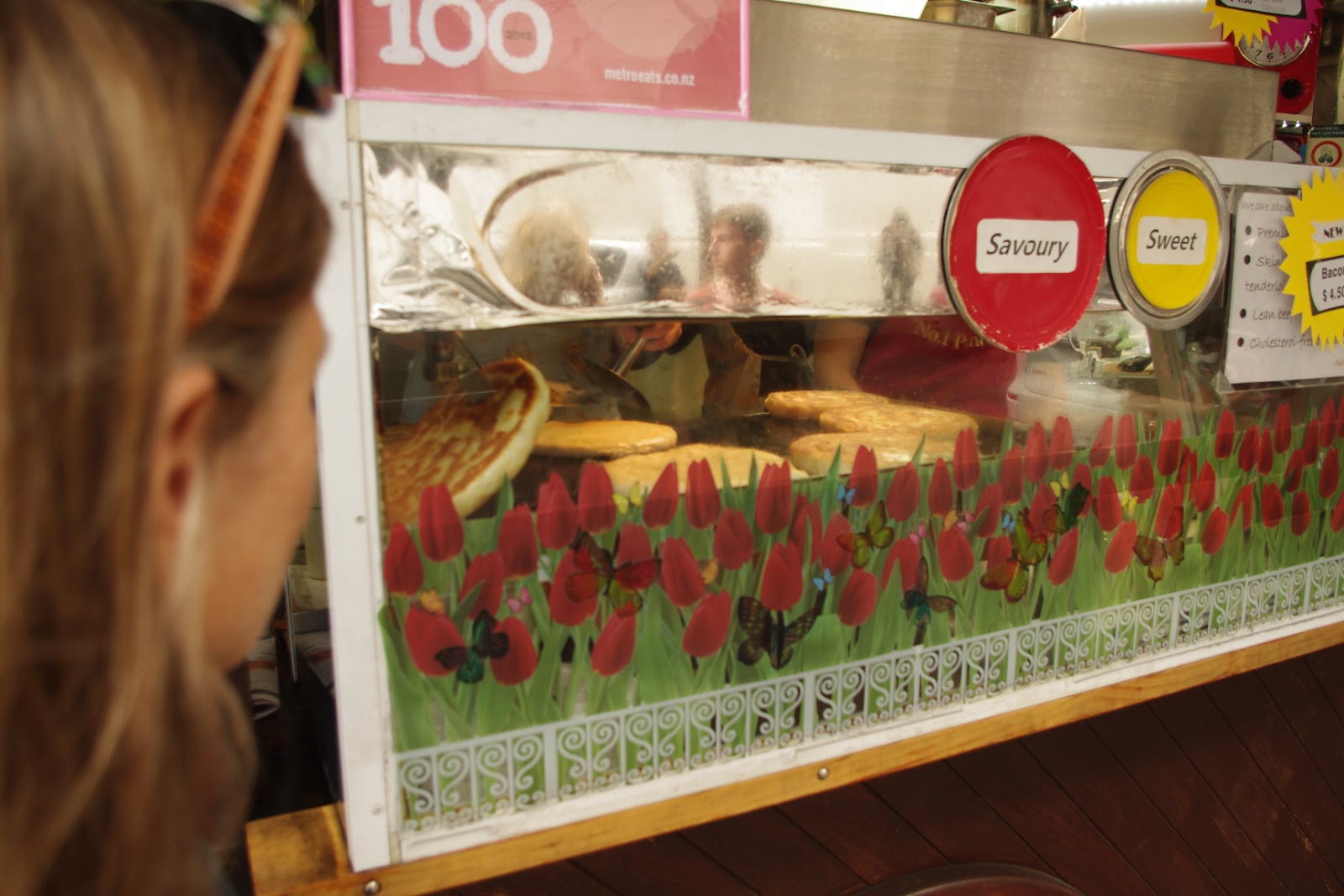
We came across the No.1 Pancake stand ...


... and each had a savory Chinese pancake.  Delicious!  Sort of a yeasty dough
like beignets with cheesy veggie filling.  I'm going to try to duplicate
it when I get home.
Lost and found
Auckland was holding an International Triathlon Competition on Saturday
and we were in the area as the elite woman biked by
Lost and found

     After we'd eaten our pancakes and watched the bikes we got up from our bench and headed up the the Auckland Art Gallery.  We had walked about 10 yards up the sidewalk when one of the women helping out with the triathlon called to us and asked, 'is this yours?', holding up our camera.  We'd left it on the bench, hidden behind my backpack, and when we got up to go both missed seeing it.  Wow, was that lucky!  It was only the first of three lost and found incidents of the afternoon.
The Art Gallery has a nice collection of NZ art.  This painting of Mount
Taranaki with a dairy processing plant in the foreground  from the 1920's
was interesting because we'd seen almost the exact scene when we were there.
This '30s painting of Maori people was revolutionary for it's time because
it wasn't an idealized vision of Maori culture, but rather showed ordinary
people in an everyday situation
    Our second chapter of Lost and Found occured when we walked up to Albert Park for a short sit to watch people and enjoy the perfect weather.  I noticed a wallet lying on the end of the bench.  We decided to stay awhile to see if anyone came back to claim it.  After fifteen minutes we wanted to get going but were reluctant to just leave the wallet there for anyone to pick up, so we opened it to see if we could come up with a phone number or email address to notify the owner, and to see if in fact there was anything of value in it at all.  
     Yikes, how about 1800 in euros, $500 in NZ dollars, and four credit cards!  That works our to over $3000 in USD!  We found the owner's personal card inside, he is a 50ish German fellow with a long noble name and a family crest imprinted with the date 1717.  With our failure to sell the van, we sort of wished we could ignore our better nature and just pull out the cash and turn the wallet in to the police.  But, having had had our camera rescued by a good Samaritan only an hour earlier, and plus it would just be really wrong, we emailed the guy and told him we'd be taking it to a nearby police station.
     Which lead to our third L&F event.  We chose a path through the University to admire the buildings and landscaping.  A massive jade plant drew our attention so we stopped to take a photo.  Earlier I'd removed my beloved wool sweater and drew it through a loop on my backpack.  Ten minutes later when we got to the police station, which was just a small branch location and closed for the weekend anyways, I started to get a little chilly and pulled off my backpack to grab my sweater. 
     Horrors!  It was gone!  I checked inside the backpack, looked around on the sidewalk, but it had disappeared.  Funny, I was more upset about losing a $5 thrift-store wool sweater than the fact that we were having difficulties selling the van.  Diana hustled off to retrace our steps and I plodded along behind, checking every corner and under every tree.  We got back to the campus and she found it hanging on a rail near the jade plant.  It put a smile on my face.
The scene of the lost sweater
     We emailed Karl Gustave zum Schlessenhof von  Heisenberger and said we'd be taking his wallet to the main station downtown instead of the the closed substation.  We hadn't gotten a return message, which was weird, since I know if I'd lost that much of a stash I'd be doing everything I could to trace it.
      Then we missed the turnoff to the station and before we knew it the crazy Auckland road system had us over the big bridge and on the other side of the harbor.  Oh well, we had to return the next morning to go to the car market, so another we sent another email.  And wondered why we hadn't heard a thing back from him.
      Back at camp we visited with our new old friends while we cooked and ate dinner, then went to bed.
     

Tuesday, April 9, 2013

Friday, April 5 - Detailing the van

     We never left the campground during the day.  I'd bought a can of cut and polish wax and went over the whole van, inside and our, rubbing out old stains and rusty bits and bringing it to a respectable shine.  Diana set our tent and cleared out our stuff, then swept and cleaned the interior.  The old Townace has never looked better.  At least while in our possession.

Thursday, April 4 - Back to Auckland

     We got back to Auckland around noon, and checked out three different campgrounds in the area to see which would be the best for our last eight days here.  We wanted something with a good camp kitchen, fairly convenient to public transportation, and a fairly short walk to buy groceries, since our main mission is to sell the van, and once it's gone we'll be without wheels.  We found a good spot just north of the city and checked in.
     There are a number of fairly permanent residents living in caravans, or cabins here, and we've already become part of the community.  We met Don at breakfast.  He's a native Ohioan who grew up in Cleveland in the 60's and 70's.  He's Native American, Ojibwe, and met and married a Maori woman in Oklahoma before moving to Alaska where he worked for ten years as a teacher in tribal villages.  Eight years ago they decided that the isolation and cold winters was enough, and decided to move to New Zealand.  Now he's back at University to become a Podiatrist.  He lives in a camper van a bit bigger than ours during the week while he takes classes at the nearby university, then commutes a couple hours home for the weekends.  He sort of looks Maori himself, although his long ponytail doesn't really fit. A really nice, and super intelligent guy, we've had some great laughs talking about growing up on Lake Erie. He remembers when the Cuyahoga would catch on fire and said an older buddy of his had a pretty nasty rash after swimming in the fetid river.  Also the heartbreak of being an Indians or Browns fan back in the day.  And he's been able to provide us with some good insight about white and Maori cultural interactions, as well as an outsiders view of New Zealand society in gerneral.
    There's also a Kiwi about our age living with his partner (wife?) in one of the cabins who has his own little cleaning business, and is interested in buying our van if he can come up with the money.  He's quite a character, life has tried to beat him down but I think he's too stubborn to let it, or perhaps even recognize that he's even been in battle.
     Bill is a 75 year old Yorkshire man with flowing white hair who lives in a small caravan.  He's a graduate of Oxford and Cambridge and did research in London in television and glass furnace technology.  When his wife tired of city life they moved back Sheffield where he had grown up in a poor neighborhood and became a teacher, and eventually principal of a high school there.  His stories of restoring a semblance of control over the '50s era punks with some rather unorthodox methods are hilarious and inspiring.  I can imagine he was a pretty powerful presence as a tough 35 year soccer player, dealing with the unruly kids in his school with charm, wit and a bit of force when necessary.
     He decided to move to New Zealand around 35 years ago when he got tired of the pollution and class system in England. He was told he'd be in a wheelchair 30 years ago because of early onset arthritis, but discovered and adopted a diet based only on raw food, and now can kick up his legs like a burlesque dancer.  He started running marathons when he was 62 and has completed 50, as well as a few 50 km runs.  Three days a week he goes to a nearby rec center to play table tennis, plays with a club team, and coaches.  I kidded him as he headed off one morning, asking him if he can beat the Chinese, and he replied earnestly, quite a few of them, and that he's pretty high up in the 'protocol'.  He's a wise man too.  One morning , a fellow who lives here was pretty drunk and spouting off about something or other, and Bill gently responded, "you know, if you look at how so many people have to live around the world, it makes you realize how lucky we have it here."  The guy sort of muttered something in grudging assent, then sulked out.
     We settled down and fixed dinner in the spacious kitchen and visited with some of the other residents, before going to bed.

Saturday, April 6, 2013

Wednesday, April 3 - Sand, water and trees

   
We had fried eggs for breakfast ...

... then we headed out to the giant sand dunes so Diana could go surfing.

Using one of the old bogey boards, she tried going down seated, which
didn't work too well
The forward prone position was a bit better, but it sure isn't like snow
sledding
The blowing sand carved interesting formations into this old foot print
We left the dunes, then drove for awhile before crossing a river on this
small ferry
We thought these would be good additions to Kris's boat yard
The most extensive stands of Kauri trees is along the west coast of Northland.
This kauri has the largest trunk of them all, 18.5 feet
in diameter.  That's a big tree!
The trees are so strangely shaped, the  huge trunk
having very little taper,  then ending in relatively
small branches at the top
    That night we stayed at a DOC campground located in a kauri forest.  After dinner we went out at dark to  see if we could find, or hear, kiwis. Because the area has been protected from predators for almost 50 years it's one of the best chances to find the elusive birds.  We went out on a trail with red cellophane covering our headlamps, and stealthily walked through the woods.  We did see glow worms and heard a few other night birds, but failed in our attempt to discover any kiwi birds.  And with that last chance, it's probably official, no in-the-wild kiwi encounters.

Tuesday, April 2 - Cape Reinga, the top of NZ

     We only had one more part of NZ to see before heading home, Cape Reinga, which points like a finger northwest towards Queensland, Australia.  We've seen some pretty amazing places in NZ and thought the cape would be an interesting, but didn't expect too much.  Boy, were we pleasantly surprised.
     But first we had some business to do.  New Zealand requires all vehicles to go through a safety inspection every six months if more than six years old.  The Irish guy we'd bought it from had paid several hundreds of dollars in repairs each time he took it in for the inspection.  And as our WOF was running out in a couple days, we had to get it renewed.  Plus,  it would be benefit to have a fresh one for the purpose of selling the van.  But how much would the repairs be?  It has been a background item of concern which has grown as we get closer to our departure date.  So we took it into a garage in Kaitiai, the last town before hitting the cape.  They told us to leave it for an hour or so while they did the inspection.
We walked to a bank to cash a few traveler's checks, then returned to the
garage.  Boy, were we relieved when it passed with no problems!
That's one dragon off our back before we can sell the van!
North of town is the Ancient Kauri Kingdom.  45,000 years ago a forest of
Kauri trees was buried in a swamp.  Now, they are dug up, preserved in the acid
muck, and used to make furniture and craft items.  This 12 foot diameter log
now serves as a spiral staircase for the shop where many Ancient Kauri
products are sold

Next we drove out to Ninety Mile Beach, which runs in a continuous
stretch all the way to the cape.  It's actually more like 90 km long, and is open
to traffic.  We weren't about to give it a try without 4WD.
Sandscape with kelp
Nearing the cape the land becomes empty of people, although you still see
sheep, cattle, and ... turkeys!?
We've seen quite a few turkeys in NZ.  Wild birds from the US were released
here a hundred years ago.  With some interbreeding with domesticated
fowl the result are these very large, semiferal birds.  They have very little
fear of people, probably because Kiwis don't celebrate
Thanksgiving.
The beautiful road out to the cape
The northernmost tip of NZ, Cape Reinga.
The Tasman Sea, which separates New Zealand  from Australia, meets the
Pacific Ocean.  Waves and surf crash as swells from opposing directions
collide here.  Wouldn't want to kayak out there.
The coast east of the cape.  We camped at a small cove there for the night.
We took a short hike along the Coastal Track.  It's too bad we've run out
of time, because we would like to explore the area more fully.
Because the lighthouse sits on a bluff a hundred meters above the sea it
didn't have to be very tall to cast its warning light beam out over the ocean.
We cooked dinner at a pulloff near the tip of the cape.
The northern top of NZ ended up serving as an exclamation point for our
entire Trip Down Under, and we toasted the country for its charm and beauty
with some decent NZ cask wine. Cheers!

Friday, April 5, 2013

Monday, April 1 - Kauri trees and toilets

      The biggest and most famous trees in NZ are called kauri.  When early settlers feasted their eyes on these behemoths they knew the best thing to do was sharpen their saws and cut them down.  Only limited areas of original stands remain, and they are amazing trees.  We went for a walk through a grove outside of Whangerie, and while not containing NZ's largest specimens, which we did get to see a few days later, we got a nice preview.

The trunk is wide and barely tapers until it abruptly
branches 50 or 60 feet up


The wood is fairly soft but very durable and
was used for everything from shipbuilding to
making furniture.  It looks a lot like cherry in
color and grain.
From the walkway we could look down at this  fern tree.  They're all over NZ,
grow up to 20 feet tall, and are as much an icon of the country as the kiwi.
Partly because at least you can see them.
Our next stop was the small town of Kawakawa, famous for its public toilets
in the center of town.

Friedensreich Hundertwasser was an Austrian Architect who designed much
more noble projects than this, but these humble toilets are a fine
example of his public work

Who wouldn't want to go here?
Kawakawa has leveraged the fame of its toilets with other wild art installations.
The cafe across the street has warren of creative art you pay $2 to walk through
and view.  

Thursday, April 4, 2013

In Auckland, preparing the van for sale

     No postings lately because we've been in the far north of the North Island.  I'll catch up soon.  We arrived in Auckland yesterday evening and found a nice motorvan park where we'll be until we leave for home next Friday.  We've spent the day getting the van cleaned up and cleared out so we can sell it.   Tomorrow morning there is a car market downtown, then another on Sunday at a nearby suburb. We'll give those a shot, and if the van doesn't sell we'll begin postings on the same site we found it almost three months ago.  I'll keep you posted.
The van looks pretty good, even before I waxed it 

We ended up putting 5600 miles on it in the last three months 

The middle seats, when laid back, proved more comfortable
to sleep on than one would think.  We did change the contour
a bit with Thermarests and mattress pad.
     We added up our total miles (not kilometers) we drove in Australia and New Zealand ... 18,000!  That's a lot of miles in seven months.  It will be nice to get home and stay in one place, even if it's only for a couple weeks (we're still haven't decided about driving out to Montana to see our German son, Julian, who leaves on May 4.  And then we'd like to drive to Connecticut to see our son David, whom we haven't seen in over a year.)